Wednesday, 26 January 2011

Swap two variables without using third and in one line

Couple of weeks back I was interviewing a fresh graduate. Even though they are taught programming, I am not sure if they take it seriously and learn or practice it well. One of the questions I asked was to swap 2 numbers without using a temp variable.

Looking back now, I think it may be a bigger challenge to ask to swap numbers without using a temp variable and in one line. Below are my three different approaches but I would advise you to try it yourself before looking at the answer.


//Program to swap 2 numbers without using 3rd variable and in one line
//Program tested on Microsoft Visual Studio 2008 - Zahid Ghadialy
#include<iostream>

using namespace
std;

void
approach1(int& a, int& b)
{

cout<<"\nApproach 1"<<endl;
a^=b^=a^=b;
}


void
approach2(int& a, int& b)
{

cout<<"\nApproach 2"<<endl;
//b=(a+b)-(a=b); - This should work but doesnt, why?
a =((a = a + b) - (b = a - b));
}


void
approach3(int& a, int& b)
{

cout<<"\nApproach 3"<<endl;
a = ((a = a * b) / (b = a / b));
}


int
main()
{

int
a = 13, b = 29;
cout<<"\nOriginal"<<endl;
cout<<"a = "<<a<<", b = "<<b<<endl;

approach1(a, b);
cout<<"a = "<<a<<", b = "<<b<<endl;

a = 13, b = 29;
approach2(a, b);
cout<<"a = "<<a<<", b = "<<b<<endl;

a = 13, b = 29;
approach3(a, b);
cout<<"a = "<<a<<", b = "<<b<<endl;

return
0;
}


The output is as follows:
Agreed that the above would be applicable only for integers.

Wednesday, 19 January 2011

'sizeof' a class

Continuation from last week. What is the sizeof of a class? Wrote a simple program as follows:


//Program tested on Microsoft Visual Studio 2008 - Zahid Ghadialy
#include<iostream>

using namespace
std;

class
A
{

int
a;
};


class
B
{

int
b;
int
someFunc(void) {return b;}
};


class
C
{

void
someFunc1(void) {};
void
someFunc2(void) {};
};


class
D : public A
{

void
someFunc(void) {};
};


int
main()
{

cout<<"Size of class A = "<<sizeof(A)<<endl;
cout<<"Size of class B = "<<sizeof(B)<<endl;
cout<<"Size of class C = "<<sizeof(C)<<endl;
cout<<"Size of class D = "<<sizeof(D)<<endl;
}


The output is as follows:

After finishing this, I found this interesting article here.

Wednesday, 12 January 2011

Checking the 'sizeof' doubts

I noticed sometime back that one of my programs behaved unexpectedly in certain scenarios which was traced to an incorrect use of sizeof. As a result, I made a small program to make sure that my understanding of sizeof is correct. Here is the program:


//Program tested on Microsoft Visual Studio 2008 - Zahid Ghadialy
#include<iostream>

using namespace
std;

int
main()
{

char
a[]="";
cout<<"Size of a[] = "<<sizeof(a)<<endl;

char
b[]=" ";
cout<<"Size of b[ ] = "<<sizeof(b)<<endl;

char
c[10];
cout<<"Size of c[10] = "<<sizeof(c)<<endl;

char
* d;
cout<<"Size of d = "<<sizeof(d)<<endl;

char
* e = c;
cout<<"Size of e = "<<sizeof(e)<<endl;

char
f[] = "123456";
cout<<"Size of f = "<<sizeof(f)<<endl;

char
g[] = {'1','2','3','4','5','6'};
cout<<"Size of g = "<<sizeof(g)<<endl;

return
0;
}


The output is as follows:
A lot of interviewers love the sizeof questions.

Have you come across any interesting sizeof problems? Please feel free to add them in comments.

Wednesday, 5 January 2011

C++ example of Linked List implementation

It is debatable if Linked lists are needed in C++, especially because STL can do a very good job for the same functionality for which Linked Lists are required. Nevertheless sometimes it maybe convenient to know linked lists.


//Program tested on Microsoft Visual Studio 2008 - Zahid Ghadialy
#include <iostream>
#include <string>
#include <istream>
#include <limits>

using namespace
std;

class
Node
{

public
:
Node() : next(NULL) {}; //default constructor
Node(const string& s1) : info(s1), next(NULL) {};
string info;
Node* next;
};


Node* getNewNode()
{

//Lets flush the input buffer first
istream& in(cin);
in.ignore( numeric_limits<std::streamsize>::max(), '\n' );

//Read the String from console
cout<<"\tEnter a string: ";
istreambuf_iterator<char> eos; // end-of-range iterator
istreambuf_iterator<char> iit (cin.rdbuf()); // stdin iterator
string s2;
while
(iit!=eos && *iit!='\n') s2+=*iit++;

//Call the constructor with the input string
Node* newNode = new Node(s2);

return
newNode;
}


int
main()
{

Node* head = NULL;
bool
contFlag = true;
char
c;

while
(contFlag)
{

cout<<"\n\n";
cout<<"0. Quit"<<endl;
cout<<"1. Traverse and Print"<<endl;
cout<<"2. Insert node at the start"<<endl;
cout<<"3. Insert node at the end"<<endl;
cout<<"4. Insert after specified number of nodes"<<endl;
cout<<"5. Remove node from the start"<<endl;
cout<<"6. Remove node from the end"<<endl;
cout<<"7. Remove node from a specified number"<<endl;

cout<<"\nEnter your choice: ";
cin>>c;

switch
(c)
{

case
'0':
contFlag = false;
break
;
case
'1':
{

Node* tempNode = head;
int
count = 0;
while
(tempNode)
{

cout<<"\tItem "<<count<<" = "<<tempNode->info<<endl;
tempNode = tempNode->next;
count++;
}
}

break
;
case
'2':
{

Node* newNode = getNewNode();
newNode->next = head;
head = newNode;
}

break
;
case
'3':
{

Node* newNode = getNewNode();

Node* endNode = head;
if
(endNode)
{

while
(endNode->next)
endNode = endNode->next;
endNode->next = newNode;
}

else
//In case its the first element
{
head = newNode;
}
}

break
;
case
'4':
{

Node* tempNode = head;
if
(tempNode)
{

unsigned
num;
cout<<"\tInsert after how many nodes? : ";
cin>>num;
Node* newNode = getNewNode();

unsigned
count = 1;
//If less elements are present then insert at the end
while(tempNode->next && (count < num))
{

tempNode = tempNode->next;
count++;
}

newNode->next = tempNode->next;
tempNode->next = newNode;
}

else

{

cout<<"\tNo nodes present yet"<<endl;
}
}

break
;
case
'5':
{

Node* firstNode = head;
if
(firstNode)
{

head = firstNode->next;
delete
firstNode;
}
}

break
;
case
'6':
{

Node* endNode = head;
if
(endNode) //Atleast one element
{
Node* endEndNode = endNode->next;
if
(endEndNode) //Atleast 2 elements
{
while
(endEndNode->next)
{

endNode = endEndNode;
endEndNode = endEndNode->next;
}

endNode->next = NULL;
delete
endEndNode;
}

else
//Only one element
{
head = NULL;
delete
endNode;
}
}
}

break
;
case
'7':
{

Node* tempNode = head;
if
(tempNode)
{

unsigned
num;
cout<<"\tRemove after how many nodes? : ";
cin>>num;

unsigned
count = 1;
//If less elements are present then return
while(tempNode->next && (count < num))
{

tempNode = tempNode->next;
count++;
}

if
(count == num && tempNode->next && tempNode->next->next)
{

Node* nodeToRemove = tempNode->next;
tempNode->next = nodeToRemove->next;
delete
nodeToRemove;
}
}

else

{

cout<<"\tNo nodes present yet"<<endl;
}
}

break
;
default
:
cout<<"Incorrect selection."<<endl;
}
}


return
0;
}


The output is as follows:
You can try more combinations and if you have ideas for improvements please add in the comments section.

Few things to note:
1. This program is for reference and I have not accounted for memory leaks after pressing '0'.
2. For simplicity, getNewNode() is shown as a seperate function. In a real program, it may be better as a method of class Node
3. General Linked Lists use Struct's but in C++, Structs and Classes are nearly the same so its better to use Class.
4. In C++ there is rarely a need to use Linked Lists. Its better to use the STL which already have vectors, stacks, lists, etc.
5. There should be check for memory allocation and try catch blocks that have been ignored for simplicity

Wednesday, 22 December 2010

String Shift and Print

After my last blog post, someone pointed out a similar problem here. The problem goes:

Write a program that generates from the string "abcdefghijklmnopqrstuvwxyz{" the following:
a
bcb
cdedc
defgfed
efghihgfe
fghijkjihgf
ghijklmlkjihg
hijklmnonmlkjih
ijklmnopqponmlkji
jklmnopqrsrqponmlkj
klmnopqrstutsrqponmlk
lmnopqrstuvwvutsrqponml
mnopqrstuvwxyxwvutsrqponm
nopqrstuvwxyz{zyxwvutsrqpon

Well there is no time limit this time and we dont even need to use google. I think this is slightly trickier than the last one.

Here is my solution:


//Program tested on Microsoft Visual Studio 2008 - Zahid Ghadialy

#include<iostream>
#include<string>

using namespace
std;

int
main()
{

string str = "abcdefghijklmnopqrstuvwxyz{";
unsigned
strlen = str.length();
string tempStr;
int
loop = 0;
while
(tempStr.length() < strlen)
{

int
start1 = loop;
int
count1 = loop + 1;
tempStr = str.substr(start1,count1);

count1--;
for
(; count1 > 0; count1--)
tempStr.append(str.substr(start1+count1-1, 1));

cout<<tempStr;
cout<<endl;
loop++;
}

return
0;
}


Wednesday, 15 December 2010

ASCII Print

Few weeks back, someone I know got asked the following question in an interview:

Write a C++ program in 15 minutes to print the following in the output:
a
bcb
cdedc
defgfed
efghihgfe
fghijkjihgf
ghijklmlkjihg
hijklmnonmlkjih
ijklmnopqponmlkji
jklmnopqrsrqponmlkj
klmnopqrstutsrqponmlk
lmnopqrstuvwvutsrqponml
mnopqrstuvwxyxwvutsrqponm
nopqrstuvwxyz{zyxwvutsrqpon

You can do search on the web for any information but all your searches would be logged and used to assess your answer.

Well my obvious guess would be to take help of ASCII table. My only search was for Ascii table in google. I did try and make it in less than 15 mins. My solution is below but do try it on your own before looking at my solution.


//Program tested on Microsoft Visual Studio 2008 - Zahid Ghadialy
#include<iostream>
#include<string>

using namespace
std;

int
main()
{

char
c=(char)97; //'a' in ASCII
char loop = 0;
while
(c <= 'n')
{

char
x = 0;
for
(; x <=loop; x++)
{

cout<<char(c+x);
}

for
(char y = 1; y < x; y++)
{

cout<<char(c+x-y-1);
}

cout<<endl;
c++;
loop++;
}


return
0;
}


Wednesday, 8 December 2010

Difference between Deep copy and Shallow copy in C++

So what is the difference between 'Deep copy' (sometimes referred to as 'Hard copy') and 'Shallow copy' in C++

Shallow copy: Copies the member values from one object into another.

Deep Copy: Copies the member values from one object into another. Any pointer objects are duplicated and Deep Copied.

There are some interesting discussions on Stack Overflow here and here. A related discussions here is interesting as well.

Program to demonstrate as follows:


//Program tested on Microsoft Visual Studio 2008 - Zahid Ghadialy
#include<iostream>
#include<string>

using namespace
std;

class
MyString
{

public
:
MyString(){}
MyString(string str)
{

size = str.size();
data = new char(size+1); //+1 for '\0'
memcpy(data, str.c_str(), size+1);
}

//MyString(const MyString& copy); - Use default for Shallow
void DeepCopy(const MyString& copy) //Deep Copy
{
size = copy.size;
data = new char(size+1); //+1 for '\0'
memcpy(data, copy.data, size+1);
}

int
size;
char
* data;
};


int
main()
{

MyString m1("Zahid");
cout<<"\nm1.size = "<<m1.size<<", &m1.data = "<<(void *)m1.data<<", *m1.data = "<<m1.data<<endl;

MyString m2(m1); //Uses the default copy constructor - Shallow Copy
cout<<"\nm2.size = "<<m2.size<<", &m2.data = "<<(void *)m2.data<<", *m2.data = "<<m2.data<<endl;

MyString m3; //Another default constructor
m3.DeepCopy(m1);
cout<<"\nm3.size = "<<m3.size<<", &m3.data = "<<(void *)m3.data<<", *m3.data = "<<m3.data<<endl;

return
0;
}


Output as follows:


Wednesday, 1 December 2010

Difference between 'new', 'new operator' and 'operator new' in C++

A question asked in a forum said:

Why does void* p = new (1024); gives me a compilation error while void* p = operator new (1024); works. What is the difference between new and "operator new"?

Lets go back to the beginning. Once upon a time there was this C language that used 'malloc' to allocate memory. Then when C++ came, a new way was defined of allocating memory by the use of 'new'. Its supposed to be much safter and better way but some software gurus may differ. Memory for 'new' is allocated from 'Free Store' and memory by 'malloc' is generated from 'heap'. The 'heap' and 'Free Store' may be the same area and is a compiler implementation detail.

The syntax for 'operator new' is:
void* new (std::size_t size);

All it does is allocate a memory of size specified

On the other hand, 'new' does 2 things:
1. It calls 'operator new'
2. It calls constructor for the type of object

In the above case since 1024 is not a type, it will fail in calling its constructor.

'new' is also referred to as 'keyword new' or 'new operator' to cause more confusion :)

Here is a small example to play with 'operator new' after the example you will realise that regardless of what is passed, it always allocates a 4 byte memory.


//Program tested on Microsoft Visual Studio 2008 - Zahid Ghadialy
#include<iostream>

using namespace
std;

int
main()
{

//void* p = new (1024);

void
* p = operator new (1024);

//Lets test if we can do anything with the memory
cout<<"p = "<<p<<endl;
cout<<"sizeof(p) = "<<sizeof(p)<<endl;
int
*x = static_cast<int *>(p);
cout<<"*x before = "<<*x<<endl;
*
x = 23456;
cout<<"*x after = "<<*x<<endl;

void
* q = operator new (0);
cout<<"\nq = "<<q<<endl;
cout<<"sizeof(q) = "<<sizeof(q)<<endl;
x = static_cast<int *>(q);
cout<<"*x before = "<<*x<<endl;
*
x = 65432;
cout<<"*x after = "<<*x<<endl;

void
* z = operator new ('a');
cout<<"\nz = "<<z<<endl;
cout<<"sizeof(z) = "<<sizeof(z)<<endl;
x = static_cast<int *>(z);
cout<<"*x before = "<<*x<<endl;
*
x = 11111;
cout<<"*x after = "<<*x<<endl;

return
0;
}


The output is as follows:


My knowledge in this area is quite limited so please feel free to improve on my explanation or correct it.

Wednesday, 24 November 2010

C++ example of State Design Pattern


The State pattern allows an object to change its behavior when its internal state changes. This pattern can be observed in a vending machine. Vending machines have states based on the inventory, amount of currency deposited, the ability to make change, the item selected, etc. When currency is deposited and a selection is made, a vending machine will either deliver a product and no change, deliver a product and change, deliver no product due to insufficient currency on deposit, or deliver no product due to inventory depletion.

The frequency of use of State Pattern is Medium but is very useful and frequently used Telecoms Protocols implementation.

Example as follows:


//Program tested on Microsoft Visual Studio 2008 - Zahid Ghadialy
//State is part of Behavioral Patterns
//Behavioral Patterns deal with dynamic interactions among societies of classes and objects
//State allows an object to alter its behavior when its internal state changes.
// The object will appear to change its class

//We will take an example Bank card where depending on the deposit the customers status changes


#include<iostream>
#include<string>
#include "main.h"


Account* State::GetAccount(void)
{

return
account_;
}

void
State::SetAccount(Account* account)
{

account_ = account;
}


double
State::GetBalance(void)
{

return
balance_;
}


void
State::SetBalance(double balance)
{

balance_ = balance;
}


string State::GetStateName(void)
{

return
stateName_;
}


RedState::RedState(State* state)
{

this
->balance_ = state->GetBalance();
this
->account_ = state->GetAccount();
Initialise();
}


void
RedState::Deposit(double amount)
{

balance_ += amount;
StateChangeCheck();
}


void
RedState::Withdraw(double amount)
{

double
newAmount = amount + serviceFee_;
if
(balance_ - newAmount < lowerLimit_)
cout<<"No funds available for withdrawal!"<<endl;
else

balance_ -= newAmount;
}


void
RedState::PayInterest()
{

//No interest is paid
}

void
RedState::StateChangeCheck()
{

if
(balance_ > upperLimit_)
{

account_->SetState(reinterpret_cast<State*>(new SilverState(this)));
delete this
;
return
;
}
}


void
RedState::Initialise()
{

stateName_ = "Red";
//Should come from a data source
interest_ = 0.0;
lowerLimit_ = -100.0;
upperLimit_ = 0.0;
serviceFee_ = 15.0;
}


SilverState::SilverState(State* state)
{

this
->balance_ = state->GetBalance();
this
->account_ = state->GetAccount();
Initialise();
}


SilverState::SilverState(double balance, Account* account)
{

this
->balance_ = balance;
this
->account_ = account;
Initialise();
}


void
SilverState::Deposit(double amount)
{

balance_ += amount;
StateChangeCheck();
}


void
SilverState::Withdraw(double amount)
{

balance_ -= amount;
StateChangeCheck();
}


void
SilverState::PayInterest()
{

balance_ = balance_ * interest_;
StateChangeCheck();
}


void
SilverState::StateChangeCheck()
{

if
(balance_ < lowerLimit_)
{

account_->SetState(reinterpret_cast<State*>(new RedState(this)));
delete this
;
return
;
}

else if
(balance_ > upperLimit_)
{

account_->SetState(reinterpret_cast<State*>(new GoldState(this)));
delete this
;
return
;
}
}


void
SilverState::Initialise()
{

stateName_ = "Silver";
//Should come from a data source
interest_ = 1.0;
lowerLimit_ = 0.0;
upperLimit_ = 1000.0;
}


GoldState::GoldState(State* state)
{

this
->balance_ = state->GetBalance();
this
->account_ = state->GetAccount();
Initialise();
}


void
GoldState::Deposit(double amount)
{

balance_ += amount;
StateChangeCheck();
}


void
GoldState::Withdraw(double amount)
{

balance_ -= amount;
StateChangeCheck();
}


void
GoldState::PayInterest()
{

balance_ = balance_ * interest_;
StateChangeCheck();
}


void
GoldState::StateChangeCheck()
{

if
(balance_ < 0.0)
{

account_->SetState(reinterpret_cast<State*>(new RedState(this)));
delete this
;
return
;
}

else if
(balance_ < lowerLimit_)
{

account_->SetState(reinterpret_cast<State*>(new SilverState(this)));
delete this
;
return
;
}

else if
(balance_ > upperLimit_)
{

cout<<"Your account is too big now. Please consider using Swiss banks"<<endl;
}
}


void
GoldState::Initialise()
{

stateName_ = "Gold";
//Should come from a data source
interest_ = 5.0;
lowerLimit_ = 1000.0;
upperLimit_ = 10000000.0;
}


Account::Account(string owner):owner_(owner)
{

state_ = reinterpret_cast<State*>(new SilverState(0.0, this)); //default
}

Account::~Account()
{

delete
state_;
}


double
Account::GetBalance(void)
{

return
state_->GetBalance();
}


void
Account::Deposit(double amount)
{

state_->Deposit(amount);
cout<<"Deposited $"<<amount<<endl;
cout<<"Balance $"<<GetBalance()<<endl;
cout<<"Status "<<state_->GetStateName()<<endl;
cout<<"\n";
}


void
Account::Withdraw(double amount)
{

state_->Withdraw(amount);
cout<<"Withdrew $"<<amount<<endl;
cout<<"Balance $"<<GetBalance()<<endl;
cout<<"Status "<<state_->GetStateName()<<endl;
cout<<"\n";
}


void
Account::PayInterest()
{

state_->PayInterest();
cout<<"Interest Paid --------"<<endl;
cout<<"Balance $"<<GetBalance()<<endl;
cout<<"Status "<<state_->GetStateName()<<endl;
cout<<"\n";
}


void
Account::SetState(State* state)
{

state_ = state;
}


State* Account::GetState(void)
{

return
state_;
}


//The Main method
int main()
{

Account* account = new Account("Dr. Who");
account->Withdraw(10.00);
account->Withdraw(30.00);
account->Withdraw(70.00);
account->Deposit(234.00);
account->Deposit(5000.00);
account->Withdraw(5200.00);
account->Deposit(1500.00);
account->Deposit(1.00);
account->Withdraw(1200.00);

delete
account;

return
0;
}


EDIT: main.h (added at a later date than the post)


using namespace
std;

//Forward Declaration
class Account;

// The 'State' abstract class
class State
{

public
:
Account* GetAccount(void);
void
SetAccount(Account* account);
double
GetBalance(void);
void
SetBalance(double balance);
string GetStateName(void);
virtual
void Deposit(double amount)=0;
virtual
void Withdraw(double amount)=0;
virtual
void PayInterest(void) = 0;
protected
:
Account* account_;
double
balance_;
double
interest_;
double
lowerLimit_;
double
upperLimit_;
string stateName_;;
};


// A 'ConcreteState' class
// Red indicates that account is overdrawn
class RedState : State
{

public
:
RedState(State* state);
void
Deposit(double amount);
void
Withdraw(double amount);
void
PayInterest();
void
StateChangeCheck();

private
:

RedState(); //Not allowed
void Initialise();
double
serviceFee_;
};


// A 'ConcreteState' class
// Silver indicates less interest bearing state
class SilverState : State
{

public
:
SilverState(State* state);
SilverState(double balance, Account* account);
void
Deposit(double amount);
void
Withdraw(double amount);
void
PayInterest();
void
StateChangeCheck();

private
:
SilverState(); //Not allowed
void Initialise();
};


// A 'ConcreteState' class
// Gold indicates high interest bearing state
class GoldState : State
{

public
:
GoldState(State* state);
void
Deposit(double amount);
void
Withdraw(double amount);
void
PayInterest();
void
StateChangeCheck();

private
:
GoldState(); //Not allowed
void Initialise();
};


// The 'Context' class - defined here as its used for forward declaration
class Account
{

public
:
Account(string owner);
~
Account();
double
GetBalance(void);
void
Deposit(double amount);
void
Withdraw(double amount);
void
PayInterest();
void
SetState(State* state);
State* GetState(void);
private
:
State* state_;
string owner_;
Account();
};


The output is as follows:

Further reading:

http://www.dofactory.com/Patterns/PatternState.aspx


Wednesday, 17 November 2010

C++ example of Observer Design Pattern

Definition: Define a one-to-many dependency between objects so that when one object changes state, all its dependents are notified and updated automatically.

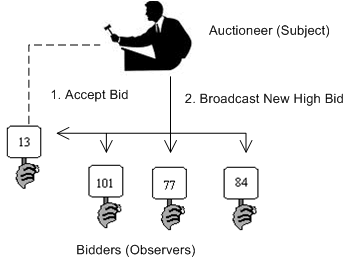
Observers register themselves with the Subject as they are created. Whenever the Subject changes, it broadcasts to all registered Observers that it has changed.


The Observer defines a one-to-many relationship so that when one object changes state, the others are notified and updated automatically. Some auctions demonstrate this pattern. Each bidder possesses a numbered paddle that is used to indicate a bid. The auctioneer starts the bidding, and “observes” when a paddle is raised to accept the bid. The acceptance of the bid changes the bid price which is broadcast to all of the bidders in the form of a new bid.

Observer is a very popular pattern and its frequency of use is very high.

The following is an example of Observer Design Pattern:


//Program tested on Microsoft Visual Studio 2008 - Zahid Ghadialy
//Observer is part of Behavioral Patterns
//Behavioral Patterns deal with dynamic interactions among societies of classes and objects
//An Observer is a way of notifying change to a number of classes.

//We will take an example of Stock Price where, Observers can register to be told about
//the stock price change of a company

#include<iostream>
#include<string>
#include<list>

using namespace
std;


//Forward Declaration
class Stock;

// The 'Observer' interface
class IInvestor
{

public
:
virtual
void Update(Stock* stock){};
};


// The 'Subject' abstract class
class Stock
{

public
:
Stock(string symbol, double price) : symbol_(symbol), price_(price) { }
void
Attach(IInvestor* investor)
{

investors_.push_back(investor);
}

void
Detach(IInvestor* investor)
{

investors_.remove(investor);
}

void
Notify()
{

list<IInvestor*>::iterator it = investors_.begin();
while
(it != investors_.end())
{
(*
it)->Update(this);
++
it;
}
}

double
GetPrice(void)
{

return
price_;
}

void
SetPrice(double price)
{

price_ = price;
Notify();
}

string GetSymbol(void)
{

return
symbol_;
}


private
:
string symbol_;
double
price_;
list<IInvestor*> investors_;

Stock();
};


// The 'ConcreteSubject' class
class Company : public Stock
{

public
:
Company(string name, string symbol, double price) : name_(name), Stock(symbol, price) {}
string GetName(void)
{

return
name_;
}

private
:
string name_;
};


// The 'ConcreteObserver' class
class Investor : public IInvestor
{

public
:
Investor(string name) : name_(name){}
void
Update(Stock* stock)
{

cout<<"Notified "<<name_<<" about "<<(reinterpret_cast<Company*>(stock))->GetName() \
<<
" change to "<<stock->GetSymbol()<<stock->GetPrice()<<endl;
}

private
:
string name_;
Investor();
};


//The Main method
int main()
{

Company* c1 = new Company("Google", "$", 123.0);
cout<<"Created company Google with Stock Price 123.0\n"<<endl;

Investor* i1 = new Investor("Billy");
c1->Attach(i1);
cout<<"Created investor Billy following Google\n"<<endl;

c1->SetPrice(125.0);

Investor* i2 = new Investor("Timmy");
c1->Attach(i2);
Investor* i3 = new Investor("Lenny");
c1->Attach(i3);
cout<<"\nCreated investor Timmy and Lenny following Google\n"<<endl;

c1->SetPrice(145.0);

c1->Detach(i1);
c1->Detach(i3);
cout<<"\nInvestor Billy and Lenny not interested in Google anymore\n"<<endl;

c1->SetPrice(165.0);

delete
i1;
delete
i2;
delete
i3;
delete
c1;

return
0;
}


The output is as follows:
Further Reading: